Tuesday, January 25, 2011

Core Impressive!

Just as I finished my previous update there was a sudden improvement in core recovery. We were at around 70 m depth and suddenly the cores looked very different – green, hard, and perfect; instead of falling to pieces with lots of washed out clay and residual fragments. Had we just crossed the main fault?

Egor, the driller, and some of the DFDP-1A team happily show off a perfect core of the principal slip surface of the Alpine Fault.

After we cleaned those cores and carefully logged them, we came to realise that we had not crossed the Alpine Fault, we were just getting the most beautiful cores. Maybe it was just the effect of increased confining pressure that resulted in better cohesion and recovery of the cataclasite. Our lab work, wireline logs and the DFDP-1B results should help to provide a scientific explanation for this change.

After 20 m of near perfect core recovery, we definitely did hit the principal slip surface. We were at 90 m depth. It was obviously the fault because there was Quaternary gravel lying beneath the thick sequence of cataclasite. The driller, “Egor”, was more excited than anyone – a perfect core across the critical zone. Fantastic!

The precious fault gouge core is now in a very secure box in a secret location and is marked “Beware of Virginia”. After reaching a depth of 96 m, we were having difficulty advancing further and for various reasons we decided to halt

drilling and then withdraw the drill string.

A perfect core of the active slip surface of the Alpine Fault from the DFDP-1A drill site, Gaunt Creek.

The project so far has been frantic, but efficient and very successful. There we were holding the first core of the Alpine Fault on Sunday evening and we were not even scheduled to start coring until the following Monday morning. We were at least 3 days ahead of schedule and it dawned on me, as project manager, that none of the other contractors were even here yet and some instruments had not even arrived from the USA. Elation started to turn into a mild panic. There was a lot of work to do and plans to change.

The revised plan and workforce has now started to fall into place, and the TV, radio, and newspapers have been on the phone all day. We reached a consensus decision today on where to site the DFDP-1B borehole and the percussion air-hammer crew has now showed up to start installing a surface casing at the new site. The current intention is to knock a 6” casing down to nearly 70 m, to try and avoid the difficult materials found in shallow parts of the DFDP-1A borehole. We are hoping to reach a total depth of around 200 m in our next borehole, if we hit solid rock beneath the fault. We start tomorrow morning.

Dave Prior decides to dig 200 m at the agreed site of DFDP-1B.

Monday, January 24, 2011

Fast Drilling

We have now completed our first 24 hours of drilling with core recovery and are several days ahead of schedule. We were not expecting to start coring operations until Monday, but we have already reached a depth of 60 m (23/1/2011, 9 a.m) in our first borehole. We are working shifts round the clock and will continue to do so until we reach our final depth. Our current hope is to intersect the fault at 100 m and continue 20 m into deformed granite beneath. However, exactly how deep we drill depends on what we find and technical feasibility. Along with our scientific goals, we recognise that specific aims of this first borehole are to find the fault (exploration) and develop both the technical methods and operational skills to sample it.

Horizon Drilling diamond coring rig at DFDP-1A drill site, Gaunt Creek. Core processing and logging is in tents behind the white container. Alex Pyne (Scientific Drilling Office, Victoria University of Wellington, NZ) is helping and training us with regard to core processing, and Brett Carpenter (Penn. State, USA) brings practical SAFOD experience. They are both helping NZ students learn the art of cleaning and then piecing cores and fragments back together. We drilled at a rate of 1.5 m/hr and obtained 56% core recovery over our first 30 m, but this will hopefully improve as our drillers hone their technique. The rock is shattered and altered to clay by the fault, so it is difficult material to collect.

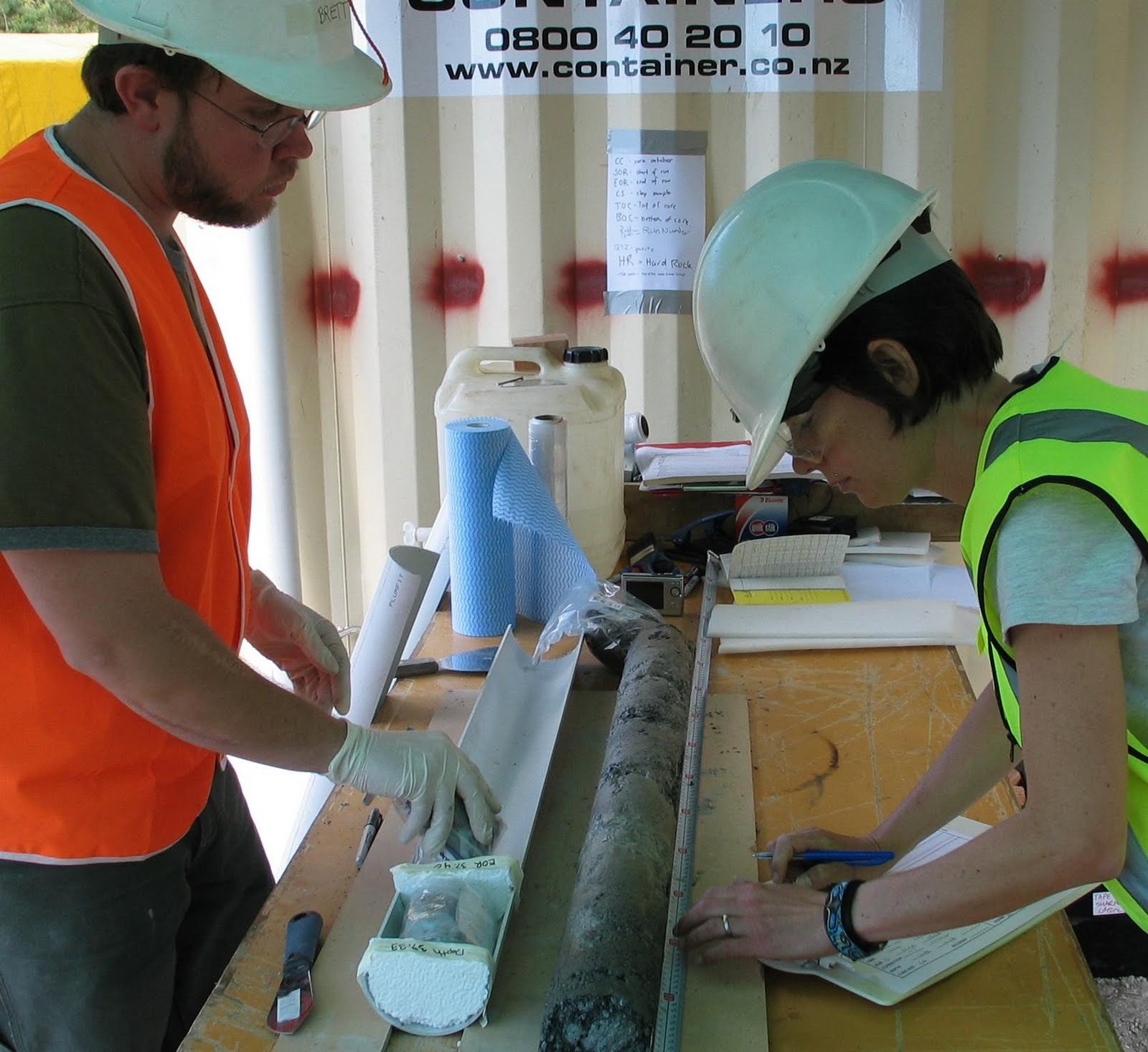
Brett Carpenter (Penn. State, USA) and Carolyn Boulton (Canterbury, NZ) process a core. They remove it from the metal split that comes out of the core barrel, clean it, record operational data and preliminary notes, and then deliver it to the logging geologists for a detailed description.

The team of logging geologists has been coordinated by Virginia Toy (Otago, NZ), and is made up of David Prior (Otago, NZ), Dan Faulkner (Liverpool, UK) and Elisabetta Mariani. The cores are described in detail, sampled in key places, and then shrink-wrapped in plastic and boxed for later analysis. The whole team has to work together to communicate what we are learning about the geology back to the drillers, so that they can predict how to better drill the next core and maximise our core recovery. This is a tough job, because nobody has ever drilled into the Alpine Fault before, and it is particularly poorly known what lies beneath the fault.

Virginia Toy inspects cores from borehole DFDP-1A. Cores are processed (background) and then logged (foreground).

And in breaking news…

Just as I am about to post this, I am seeing some spectacular cores from near 70 m depth. I think we may have just crossed the principal slip surface of the Alpine Fault and passed into rocks that are very poorly known, but seem to produce great looking cores. I will post a further update after the cores have been cleaned, logged, and the science team have discussed them.

Our video that describes the project is here

Friday, January 21, 2011

Getting deeper into the Deep Fault Drilling Project,

We have now parked up the rotary air hammer drilling rig and cleared the site for setup of the diamond coring rig that we hope will arrive tomorrow (Friday), along with the rest of our geology team. Wireline logging equipment is en route from the USA and should arrive in New Zealand at the beginning of next week. It is great to have made progress so fast and we are hoping to start coring operations on Saturday, two days ahead of schedule.

In the photo, Virginia Toy and John Butt are looking pleased to have made such great progress. The Alpine Fault is exposed in the cliff face just above their heads, 150 m behind them.

In addition to the start of drilling activities, a team of people led by Rob Langridge (GNS Science) and Greg de Pascale (Canterbury Uni.) have confirmed Alpine Fault location to the north of our drill site and found basement rock exposed at the surface; and a seismic reflection survey led by Andrew Gorman (Otago Uni.) is almost complete at the drill site, which will help to tie geophysical properties of the fault zone with drilling results.

This is a really great start, thanks to the big team of people that have already helped.

Thursday, January 20, 2011

Drilling into New Zealand's Alpine Fault

The Deep Fault Drilling Project is now happening with the first steps at our first drill site underway. We have chosen a site beside Gaunt Creek, near to Whataroa on New Zealand's West Coast. Next to us the Alpine Fault is actually visible in cross section in a cliff beside the creek

For an overview and brief introduction to this project see Julian's Blog or check out the video below.

After several days of road improvements to access our drill site, Jimmy Arnold’s efforts were put to the test yesterday with the arrival of the trucks. The first truck weighed 42 tonnes and had difficulty getting round a few corners, but the road performed well and everything got to the drill site before lunch.

Three large trucks, at least half a dozen smaller vehicles, and a digger established our site. By
the time we stopped for dinner we had already hammered down 24 m of steel casing using a
Concentrix rotary air hammer system operated by John Butt.

Despite not expecting to start sampling for a few more days, we jumped into action and logged
cuttings and drilling progress. At the base of 9 m of bouldery gravel we hit water-charged sand and then passed into cuttings of homogeneous mylonite with abundant clay. The easy penetration and high saturation of water and clay indicated that, although we had reached the target of basement rock, it was unlikely to core easily or leave a stable borehole wall. We continued to knock down casing. Conditions improved below 19 m depth, with much less water and a moderate but stable drilling rate.

This morning we added one additional 6 m casing. From 20-30 m depth we had observed a stable drilling penetration rate through relatively dry (impermeable) fractured rock and there was a consensus between myself, Virginia Toy (Otago University), and the drillers John Butt (Butt drilling), Ken Mears (Westmere Drilling) and Brent Herrick (Horizon Drilling) that we now had a stable base to start coring operations from.

Here is the video that outlines the purpose of the project